Saturday, November 30, 2013

COMET ISON LIVES

Cancel the funeral. Comet ISON is back from the dead. On Nov. 28th, Comet ISON flew through the sun's atmosphere and appeared to disintegrate before the cameras of several NASA and ESA spacecraft. This prompted reports of the comet's demise. Hours later the comet revived, sprouted two tails and rapidly brightened. It is now receding from the sun with a fair chance of becoming a photographic object in the morning sky as early as Dec. 2nd or 3rd. A new coronagraph movie from SOHO documents the flyby (updated Nov. 30 @ 00:09 UT):


Before the flyby, experts had made many predictions about what might happen to the comet, ranging from utter disintegration to glorious survival. No one predicted both.

Karl Battams of NASA's Comet ISON Observing Campaign says, "[colleague] Matthew Knight and I are ripping our hair out right now as we know that so many people in the public, the media and in science teams want to know what's happened. We'd love to know that too! Right now, here's our working hypothesis:

"As comet ISON plunged towards to the Sun, it began to fall apart, losing not giant fragments but at least a lot of reasonably sized chunks. There's evidence of very large dust in the long thin tail we saw in the [SOHO coronagraph] images. Then, as ISON plunged through the corona, it continued to fall apart and vaporize, losing its coma and tail completely just like sungrazing Comet Lovejoy did in 2011. What emerged from the Sun was a small but perhaps somewhat coherent nucleus that has resumed emitting dust and gas for at least the time being."

Battams emphasizes that it is too soon to tell how big the remnant nucleus is or how bright the resurgent comet will ultimately become. "We have a whole new set of unknowns, and this ridiculous, crazy, dynamic and unpredictable object continues to amaze, astound and confuse us to no end. We ask that you please be patient with us for a couple of days as we analyze the data and try to work out what is happening."

Courtesy - spaceweather.com

Friday, November 29, 2013

Few updates on universetoday.com showing fate of ISON

Update, 8:35 p.m. EST: Uncertainty about Comet ISON’s fate likely will persist for some time. Karl Battams just tweeted that after 2,000 sungrazing comet observations, he has never seen brightening in the same way that ISON (or its remains) appear to be doing right now. We’ll keep watching. Real-time images are available on this website.

Update, 6:30 p.m. EST: An excellent blog post from Phil Plait (who writes the Bad Astronomy blog on Slate) summarizes his take of the comet’s fate; debris (most likely, he says) continues to show up in images. An except: “It held together a long time, got very bright last night, faded this morning, then apparently fell apart. This isn’t surprising; we see comets disintegrate often enough as they round the Sun. ISON’s nucleus was only a couple of kilometers across at best, so it would have suffered under the Sun’s heat more than a bigger comet would have. Still, there’s more observing to do, and of course much data over which to pore.”

Update, 4:40 p.m. EST: On Twitter, the European Space Agency (quoting SOHO scientist Bernhard Fleck) said the comet is gone. Separately, the Naval Research Laboratory’s Karl Battams posted that he thinks recent observations show debris from ISON, but not a nucleus. Astronomers are still monitoring, however.

Update, 3:56 p.m. EST: Something has emerged from perihelion, but the experts are divided as to whether it’s leftovers of ISON’s tail, or the comet itself. 

Comet ISON Fizzles as it Rounds the Sun

Comet ISON went around the sun on Nov. 28, 2013. Several solar observatories watched the comet throughout this closest approach to the sun, known as perihelion. While the fate of the comet is not yet established, it is likely that it did not survive the trip. The comet grew faint while within both the view of NASA's Solar Terrestrial Relations Observatory, and the joint European Space Agency and NASA's Solar and Heliospheric Observatory. The comet was not visible at all in NASA's Solar Dynamics Observatory.


"We didn't see Comet ISON in SDO," said Dean Pesnell, project scientist for SDO.


This image from NASA's Solar Dynamics Observatory shows the sun, but no Comet ISON was seen. A white plus sign shows where the Comet should have appeared. It is likely that the comet did not survive the trip.
Image Credit: NASA/SDO

"So we think it must have broken up and evaporated before it reached perihelion."

While this means that Comet ISON will not be visible in the night sky in December, the wealth of observations gathered of the comet over the last year will provide great research opportunities for some time. One important question will simply be to figure out why it is no longer visible.

Courtesy - Karen C. Fox
NASA's Goddard Space Flight Center, Greenbelt, Md. NASA/SDO/ESA/SOHO/GSFC

Thursday, November 28, 2013

ISON animation of images till few hours back


ISON updates

Comet ISON is brightening rapidly as it plunges into the sun's atmosphere. At closest approach around 1:45 p.m. EST (18:45 UT) on Nov. 28th, the comet will be little more than a million kilometers above the sun's fiery surface. Temperatures around ISON's icy nucleus could rise as high as 5000 deg C.  No one knows if it can survive that kind of baking.

Researchers have been wondering what might happen if a CME strikes Comet ISON. They might find out before the day is over. As the movie shows, CMEs are billowing away from the sun in all directions. Avoiding a collision will become increasingly difficult as the comet moves closer to active regions on the sun's surface.

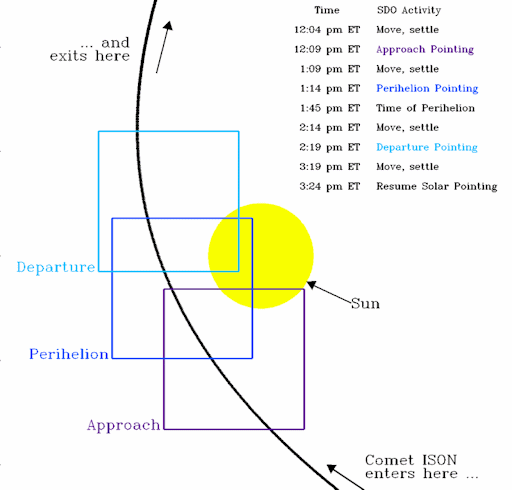
During the hours around closest approach, NASA's Solar Dynamics Observatory (SDO) will take high-resolution pictures of the comet flying through the sun's atmosphere. This diagram illustrates the sequence of events:


Usually, SDO points straight at the sun. In this case, however, the observatory is being offset and moved three times to track the speeding comet. SDO images of sungrazing Comet Lovejoy in Dec. 2011 were dramatic. Comet ISON could be even better.

Wednesday, November 27, 2013

Comet Ison enters SOHO's LASCO C3 field of view

Created from first 8 images 

IS COMET ISON IN TROUBLE?


Astronomers using the IRAM millimeter telescope in Spain are reporting a sharp change in Comet ISON. "We observe consistent, rapid fading of the molecular emission lines between Nov. 21 and Nov. 25 by at least a factor of 20. This may indicate that the nucleus is now at best marginally active or that... it no longer exists," says Michal Drahus of Caltech.

Astronomer Karl Battams of NASA's Comet ISON Observing Campaign comments: "[The fading emission lines] could indicate that the nucleus has completely disrupted, releasing an enormous volume of dust while significantly reducing emission rates. Fragmentation or disruption of the nucleus has always been the highest risk factor for this comet so if this has indeed happened then while unfortunate, it would not be a surprise."

"However," he continues, "these reports are new, and while they are undoubtedly valid, we do still need to keep observing the comet to be sure what it happening. Remember: Comet ISON is a dynamically new sungrazing comet, fresh in from the Oort Cloud, and the last time we saw an object like this was never! Furthermore, a sungrazing comet just three days from perihelion has never been studied in this kind of detail - we're breaking new ground! When we factor in your standard 'comets are unpredictable' disclaimer, what we have is a huge recipe for the unknown.

Courtesy - Spaceweather.com