

Thursday, November 28, 2013

ISON updates
Comet ISON is brightening rapidly as it plunges into the sun's atmosphere. At closest approach around 1:45 p.m. EST (18:45 UT) on Nov. 28th, the comet will be little more than a million kilometers above the sun's fiery surface. Temperatures around ISON's icy nucleus could rise as high as 5000 deg C. No one knows if it can survive that kind of baking.
Researchers have been wondering what might happen if a CME strikes Comet ISON. They might find out before the day is over. As the movie shows, CMEs are billowing away from the sun in all directions. Avoiding a collision will become increasingly difficult as the comet moves closer to active regions on the sun's surface.
During the hours around closest approach, NASA's Solar Dynamics Observatory (SDO) will take high-resolution pictures of the comet flying through the sun's atmosphere. This diagram illustrates the sequence of events:

Usually, SDO points straight at the sun. In this case, however, the observatory is being offset and moved three times to track the speeding comet. SDO images of sungrazing Comet Lovejoy in Dec. 2011 were dramatic. Comet ISON could be even better.
Researchers have been wondering what might happen if a CME strikes Comet ISON. They might find out before the day is over. As the movie shows, CMEs are billowing away from the sun in all directions. Avoiding a collision will become increasingly difficult as the comet moves closer to active regions on the sun's surface.
During the hours around closest approach, NASA's Solar Dynamics Observatory (SDO) will take high-resolution pictures of the comet flying through the sun's atmosphere. This diagram illustrates the sequence of events:
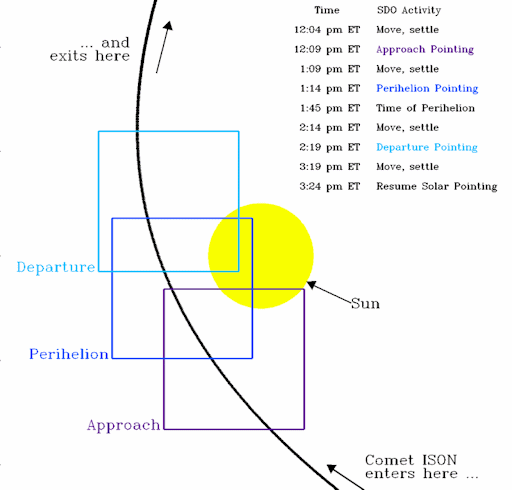
Usually, SDO points straight at the sun. In this case, however, the observatory is being offset and moved three times to track the speeding comet. SDO images of sungrazing Comet Lovejoy in Dec. 2011 were dramatic. Comet ISON could be even better.
Wednesday, November 27, 2013

IS COMET ISON IN TROUBLE?
Astronomers using the IRAM millimeter telescope in Spain are reporting a sharp change in Comet ISON. "We observe consistent, rapid fading of the molecular emission lines between Nov. 21 and Nov. 25 by at least a factor of 20. This may indicate that the nucleus is now at best marginally active or that... it no longer exists," says Michal Drahus of Caltech.
Astronomer Karl Battams of NASA's Comet ISON Observing Campaign comments: "[The fading emission lines] could indicate that the nucleus has completely disrupted, releasing an enormous volume of dust while significantly reducing emission rates. Fragmentation or disruption of the nucleus has always been the highest risk factor for this comet so if this has indeed happened then while unfortunate, it would not be a surprise."
"However," he continues, "these reports are new, and while they are undoubtedly valid, we do still need to keep observing the comet to be sure what it happening. Remember: Comet ISON is a dynamically new sungrazing comet, fresh in from the Oort Cloud, and the last time we saw an object like this was never! Furthermore, a sungrazing comet just three days from perihelion has never been studied in this kind of detail - we're breaking new ground! When we factor in your standard 'comets are unpredictable' disclaimer, what we have is a huge recipe for the unknown.
Courtesy - Spaceweather.com
Tuesday, November 26, 2013
ISON few hours from entering into SOHO's C3 field of view
In another 10 hours enters in SOHO's LASCO C3 field of view at 2:00 UT (7:30 IST) Nov 27th
Is Comet ISON disintegrating?
There has talk for some days about whether Comet ISON has fragmented. The sungrazing comet experts were saying no, but Monday morning Karl Battams – one of the great communicators at NASA’s Comet ISON Observing Campaign website – said that something is happening to the comet. There are signs it may be fragmenting. He wrote:
There’s evidence that ISON’s nucleus might not be holding up well (by which I mean falling apart!) It was always a possibility…we’ll see!
Later, he added:
It is absolutely conceivable that ISON remains in one piece, and is just being a sungrazer.
In other words, the word isn’t in yet on whether ISON is still intact.
The evidence for ISON’s possible disintegration comes in the form of a rapid drop in emissions, in recent days, from a certain kind of molecule (hydrogen cyanide molecule) known to be embedded in cometary ice. At his Bad Astronomy blog on Slate, Phil Plait explained that it’s the ice of a comet like ISON that holds the comet together. ISON is full of fresh ice. It’s a first-time visitor from the Oort comet cloud surrounding our solar system. If enough ice boils off the comet as it gets closer to the sun, the comet will literally fall apart.
But how much ice has ISON lost? Enough so that the comet will fall apart? Meanwhile, dust has also been observed to be pouring from the comet. These signs could mean that ISON’s nucleus has completely disrupted. Or not.
Why don’t astronomers know what will happen? Karl Battams explained:
… these reports are new, and while they are undoubtedly valid, we do still need to keep observing the comet to be sure what it happening. Remember: Comet ISON is a dynamically new sungrazing comet, fresh in from the Oort Cloud, and the last time we saw an object like this was never! Furthermore, a sungrazing comet just three days from perihelion has never been studied in this kind of detail – we’re breaking new ground here! When we factor in your standard ‘comets are unpredictable’ disclaimer, what we have is a huge recipe for the unknown.
We do know that, after traveling at least a million years from the Oort Cloud, Comet ISON is now plummeting fast toward the sun. Its perihelion or closest point to the sun will be on November 28 – Thanksgiving Day in the U.S. At perihelion, the comet will be traveling at 248 miles per second, encountering solar temperatures of up to 5,000 degrees Fahrenheit.
Thus this week will bring Comet ISON’s moment of truth, its day of reckoning. The comet is close to the sun on our sky’s dome now and won’t be seen from Earth this week except, perhaps, by a few experienced observers. However, NASA and ESA’s fleet of sun-observing spacecraft will be watching it.
If it survives its passage near the sun, Comet ISON will return to our skies in early December, and, indeed, early December may be the best time to try to see the comet … if there is a comet left to see.
Courtesy - earthsky.org
COMET MOVIE--UPDATED
In the movie, which spans a three+ day period from Nov. 20 to Nov. 23, the sun is to the right, off-screen. At first glance, Earth and Mercury appear to be labeled backwards. The strange arrangement is actually correct. This is how the two planets appear from STEREO-A's vantage point over the farside of the sun.

"The dark 'clouds' moving from left to right are density enhancements in the solar wind, and these are what are causing the ripples you see in the comet tails," explains Karl Battams of NASA's Comet ISON Observing Campaign.
The ripples could become even more dramatic if a CME hits the comets. This is Comet ISON's first visit to the sun, but Comet Encke has been here before. In 2007 a CME hit Encke and ripped off its tail. Battams and other researchers hope something similar is about to happen now.
Coutsey - Spaceweather.com
"The dark 'clouds' moving from left to right are density enhancements in the solar wind, and these are what are causing the ripples you see in the comet tails," explains Karl Battams of NASA's Comet ISON Observing Campaign.
The ripples could become even more dramatic if a CME hits the comets. This is Comet ISON's first visit to the sun, but Comet Encke has been here before. In 2007 a CME hit Encke and ripped off its tail. Battams and other researchers hope something similar is about to happen now.
Coutsey - Spaceweather.com
Subscribe to:
Posts (Atom)